You won’t create a successful B2C AI startup without using LLM streaming.
Why data streaming is essential for your customers and, ultimately, for your business: how it directly impacts revenue, and which LLM model suits an AI-powered B2C product, backed by our own tests.

Abstract: In this article, we explore why data streaming is essential for your customers and, ultimately, for your business.
We discuss how streaming directly impacts revenue and why, without it, platforms like YouTube ($455B market cap) and Netflix ($323B) wouldn’t exist.
Most importantly, we’ll conduct sophisticated tests and guide you in choosing the most suitable LLM model for AI-powered digital products that require streaming.
Are you curious about what impacts engagement, retention, sales, conversions — and everything else that keeps your business thriving?
It boils down to one crucial factor: User Experience (UX).
In the B2C world, your users are at the heart of your revenue. Every piece of their experience — from product performance, load speeds, and response times to the look and feel of your interface — shapes how long they stay, how often they return, and how likely they are to engage further.
And here’s the kicker: the longer they stay, the more they drive your growth. It’s that simple.
revenue increase per visitor after Rakuten invested in app performance, with conversions up 33.13%.
sales increase after Vodafone improved website loading speed by 31%.
of consumers are more likely to stay loyal to a brand that provides a visually appealing and easy-to-navigate app.
of users say that app speed and performance influence their loyalty to a brand.
Source: wpostats.com
Let’s shift our focus a little.
Imagine YouTube. Would you be willing to wait around if watching the Monaco F1 race felt like waiting for a snail to finish the track? Or Netflix — how many people would really sit around as their favorite 4K movie buffers endlessly?
In today’s world of instant gratification, a slow experience feels like a broken promise.
So, how do they deliver crystal-clear, on-demand video within milliseconds?
It’s streaming. Breaking down data into manageable pieces and sending them as they’re ready. It’s not just a nice touch; it’s the backbone of a smooth, reliable, and exclusive user experience.
“But my digital product doesn’t involve video or audio streaming. What if it’s all about AI?” — you might be asking.
The result? Immediate responses that keep users engaged, delighted, and, most importantly, loyal. In addition, users can begin to grasp information immediately, increasing their productivity.
Hypotheses.
To understand LLM streaming’s true impact, we set out to test several vital hypotheses. These questions guide our exploration and help uncover the nuances of streaming versus non-streaming approaches in real-time applications:
- Speed: Streaming vs. Non-streaming.
Is the final response from streaming longer than from non-streaming? If so, how much longer? - Higher performance, higher security?
This question probes whether the investment in streaming justifies its impact on performance and stability. - OpenAI GPT vs. Google Gemini vs. Meta Llama.
Who is faster, more secure, and cheaper?
Let’s find out.
Test.
To illuminate the cost, security, and performance nuances between streaming and non-streaming, we tested three models — GPT, Gemini, and Llama.
And by running 1000 unique prompts, we achieved a refined, realistic view of each model’s capabilities, revealing distinctive strengths and trade-offs in practical, real-world usage.
Model comparison.
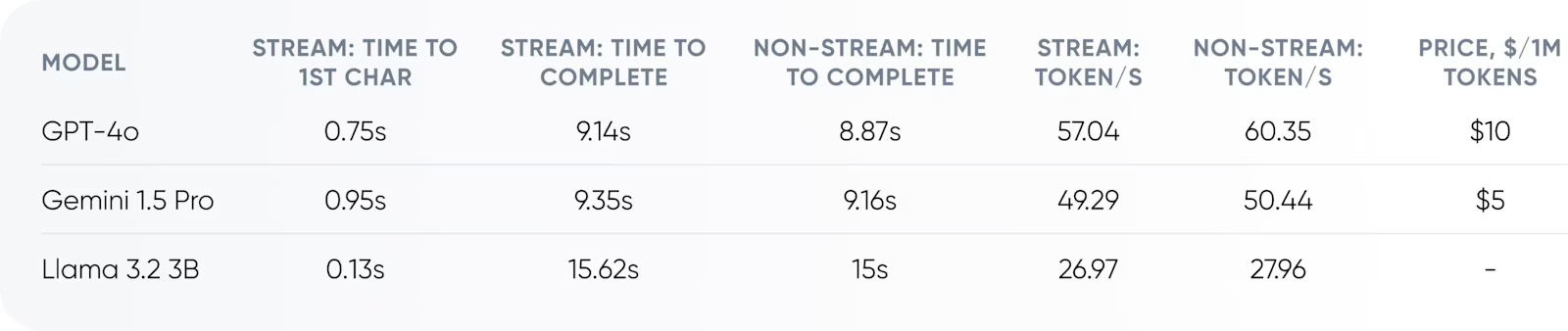
On the surface, GPT and Gemini offer almost identical response times. But look closer.
GPT delivers:
- 25% faster initial response, streaming.
- 3% faster completion, both streaming and non-streaming.
- 20% higher token throughput.
- But at twice the price.
Security.
Both OpenAI and Gemini use the HTTP Server-Sent Events (SSE) protocol for real-time streaming, yet they implement it differently:
- OpenAI streams token by token, creating a seamless, word-by-word flow.
- Gemini, on the other hand, employs chunk-based streaming, sending larger sections at once (4–8 words).
Why does this matter? Because these subtle differences in streaming go beyond technology — they shape user experience and impact security:
- OpenAI’s token-by-token approach immerses users in a conversational rhythm that feels natural and engaging.
- Gemini’s chunk-based approach, while perhaps less fluid, supports more rigorous security checks.
Two distinct paths, each leading to its own kind of excellence.
In our tests, Gemini flagged 8% of security errors during streaming, whereas OpenAI flagged none. This suggests that Gemini’s chunked streaming empowers it to enforce broader content moderation, making it a compelling choice for managing sensitive data and caring about end-users.
Note: However, Gemini lets you precisely tune the security threshold and adapt to premium digital product needs.
What about llama?
The Llama model was launched in a local setup, which makes it distinct in several ways compared to GPT and Gemini, which are only accessible via API. As an open-source model, Llama can be run on private servers, making it much more flexible:
- Fast initial response without network delays.
Running locally, Llama faced no network delays, resulting in the fastest initial response time. - Adjustable response speed through hardware.
Despite its quick start, Llama had the slowest overall response speed, which can be improved by deploying it on more powerful hardware. - Customizable streaming and security options.
Llama supports flexible streaming options. Since it’s locally deployed, it can be switched to chunk-based streaming, with custom security features added as needed. - Cost-effective, open-source advantage.
While Llama is free to use as an open-source model, deploying it requires server resources. However, this local setup allows you to manage computational resources based on usage, scaling up or down as needed to optimize costs and performance.
Conclusion.
In today’s fast-paced digital landscape, where every second shapes user experience, streaming is an undeniable game-changer — delivering responses 10.2x faster and significantly enhancing user engagement.
This speed fosters a UX that keeps users connected, satisfied, and eager to return.
The models we tested: GPT outperforms Gemini with a 25% faster initial response in streaming mode and a 3% edge in non-streaming mode, a distinction that makes all the difference in dynamic, real-time applications. However, this performance comes at a premium, as GPT's cost is double that of its closest competitor, a factor to weigh when balancing budget and speed.
Yet, the choice isn’t just about speed — Gemini’s chunk-based streaming offers robust security checks that flag potential issues, a feature especially valuable for managing sensitive data.
For those seeking the ultimate flexibility, Llama is free, and its local setup transforms it into a customizable powerhouse, making it an ideal choice for teams aiming to manage performance, cost, and security all in one place.
In short, streaming isn’t just an enhancement; it’s a necessity in delivering modern, responsive UX. Whether you prioritize speed, budget, or security, selecting the right model for your B2C AI product can empower you to meet and exceed user expectations — because in this space, every millisecond matters.