OUR CULTURE

Reliqio culture.

How we work matters as much as what we build. Consider this page our manifesto. It describes how decisions get made, how feedback works, what we expect from each other, and why the best people we've worked with tend to stay.

WHO WE ARE

Seeking excellence.

Reliqio is the technical product partner that builds AI-powered B2C products for startups designed to retain users, lift conversion, and compound LTV. Our partners are ambitious visionaries in finance, healthcare, and e-commerce who refuse to settle for products people try once and never open again.

That standard doesn't start at the codebase. It starts with the people — and the culture that shapes how they work. Frameworks can be copied. What makes Reliqio distinct is how deeply we:

1
Encourage decision-making by the people closest to the problem.
We hire for judgment and then trust it. Team members don't escalate decisions they can make themselves.
2
Share information openly, broadly, and deliberately.
Strategy memos, product performance data, engagement metrics — shared by default, not by request. Informed people make better decisions.
3
Communicate candidly and directly.
We say what we think, respectfully and without delay. Indirect feedback helps no one.
4
Keep only our highly effective and trustworthy people.
We hold a high bar and we're honest about it. Great teammates deserve to work alongside other great teammates.
5
Responsibility over rules.
We'd rather have a team that thinks than a team that follows procedures. Rules exist where safety, compliance, or a client's money demands them. Everywhere else, we trust judgment.

What we value most is talented people working together on hard problems. That's why our core philosophy is people over process. A great team with minimal structure will outperform an average team with perfect processes — every time. As we grow, we add structure only where it's necessary, never where it replaces thinking.

WHAT WE VALUE

Valued behaviors.

A company's real values aren't on the wall. They're visible in who gets hired, who gets promoted, and who gets let go. These are the specific behaviors and skills we care about most. If they describe you and the kind of people you want to work alongside, you'll do well here.

No Asset

Judgment.

  • You make sound decisions with incomplete information.
  • You use data to sharpen intuition, not replace it.
  • You look past symptoms to find root causes.
  • You optimize for long-term impact, not the next sprint.
No Asset

Selflessness.

  • You optimize for Reliqio, not your team or your ego.
  • You're genuinely open to better ideas, regardless of who has them.
  • You make time to help colleagues outside your immediate scope.
No Asset

Courage.

  • You make hard calls without unnecessary delay.
  • You take informed risks and accept that some will fail.
  • You challenge behavior that contradicts these values, regardless of seniority.
No Asset

Communication.

  • You listen to understand, not to respond.
  • You stay composed under pressure.
  • Your writing and thinking are concise and clear.
No Asset

Inclusion.

  • You work well with people who think, look, and live differently than you.
  • You actively build teams where everyone feels respected and welcome.
  • You recognize your own biases and work to counteract them.
No Asset

Integrity.

  • You're known for transparency and honesty.
  • You never say something about a colleague that you wouldn't say to them directly.
  • You own your mistakes openly and share what you learned.
No Asset

Passion.

  • You care about Reliqio's success beyond your own role.
  • You inspire the people around you through your work ethic.
  • You're genuinely excited about what you're building.
No Asset

Innovation.

  • You develop ideas that create measurable impact.
  • You look for every opportunity to reduce complexity.
  • You challenge assumptions and propose better approaches.
No Asset

Curiosity.

  • You learn quickly and seek it out actively.
  • You look for perspectives that challenge your own.
  • You see patterns and connections others miss.

Writing these down is easy. Living them is harder. We hold each other accountable — leaders first.

HOW FEEDBACK WORKS

Honest, productive feedback.

At Reliqio, feedback is continuous. Not annual, not quarterly — daily. Giving honest feedback takes courage; receiving it takes selflessness. Both depend on trust, which is why we invest heavily in building strong professional relationships.

We know this level of candor is hard — for new hires, for people from cultures where direct feedback is rare, and wherever there's a power imbalance. But it's what makes us better, individually and collectively. We coach people on how to give feedback well, and we model it from the top.

WHO WE HIRE

Dream team.

Three months into our largest digital health engagement, the scope changed underneath us. The client's compliance requirements turned out to be far more layered than anyone had mapped during discovery. The timeline was fixed. The team was already at capacity.

Our lead designer went quiet for two days and came back with a different onboarding flow — one that treated the compliance constraint
as a design input, not an obstacle. On Monday she pulled two engineers into a room. By Tuesday, it was working. The client's compliance lead later called it one of the most elegant solutions their team had reviewed.

She did that because she trusted the team to back her.
That is the actual asset. A dream team is skilled people who feel safe enough to take initiative, honest enough to challenge each other, and committed enough to care past the borders of their own role.

How we pay. We pay at the top of each person's market value — what they'd realistically earn in a comparable role elsewhere, combined with what it would cost us to replace them.

Some people's value rises quickly due to performance or demand. For others, it holds steady despite consistent work. We're transparent about both. No one should have to guess what they're worth here.

Team, not family. Families are unconditional. Teams are built around shared standards and mutual accountability. We care deeply about each other, and we also understand that the roster evolves. Performance, growth, and impact matter more than how long someone has been here.

The keeper test. Managers regularly ask themselves: if this person told me they were leaving, how hard would I fight to keep them? If the answer takes too long, we have an honest conversation. Sometimes that leads to a new challenge. Sometimes it leads to a respectful departure with real support. Either way, nobody is left in the dark. We keep people who raise the bar. We part ways generously with those who don't.

Character matters as much as capability. Someone who produces great work but makes the people around them worse isn't adding value. Collaboration here requires mutual respect. Not as a preference. As a condition.

Impact over hours. We care about what you ship, not how long you were online. Sustained high output with a balanced schedule will always earn more recognition here than visible exhaustion with average results.

Your growth is yours. Working on hard problems alongside demanding colleagues builds skills and a reputation that are yours. We encourage outside conversations, industry involvement, and even interviews elsewhere. Your market value should grow while you're here. If it doesn't, that's on us.

Moments from Reliqio social media: an app in use, the team, a conference, a podcast recording

Reliqio on social.

HOW WE WORK

Freedom and responsibility.

Early on, we introduced approval layers to prevent mistakes. The error rate dropped — and so did the pace of innovation, the quality of initiative, and the willingness to propose ideas that needed room to develop. We reversed course within a month.

The principle stuck: process should serve the work, not replace the thinking behind it. The moment you introduce a rule to prevent one person's mistake, you slow down 20 people who would have handled it well.

We hire people with strong judgment, share full context with them, and trust them to act. The person closest to the problem usually sees the answer first. Our job is to make sure they have the information and the confidence to move on it.

Freedom paired with ownership is how we operate. If something needs fixing, you fix it. If a decision needs making and you have the context, make it. Nobody here waits for permission when they already know the right call.

What this looks like in practice:

1
Open by default.
Our strategy, our numbers, our product data — shared broadly, without anyone having to ask. People working without the full picture make worse decisions than people trusted with it. Client data is the one exception, and it's covered below.
2
No vacation tracking.
The policy is simple: take vacation. Leaders model this by doing it themselves and returning with sharper thinking. We trust each other to manage the balance.
3
Managers as context-setters.
Your manager's role is to ensure you have the information, perspective, and support to make sound decisions. Not to approve every decision you make.

There are hard boundaries. Ethics, safety, harassment, data security — zero tolerance, no gray area. Outside those lines, we default to trust. When someone makes a mistake, we address it and learn from it. We don't write a new policy around it.

In our line of work, the real risk isn't that someone makes a wrong call. It's that too many rules stop people from making any call at all.

WHO DECIDES

One owner per decision.

For every significant decision, one person owns the outcome — the person with the most relevant expertise and context. Their responsibility is to listen broadly, consider carefully, and then make the call.

This doesn't mean deciding in isolation. On smaller decisions, a brief message is enough. On larger ones — architectural direction, client commitments, strategic shifts — the owner documents the positions, actively seeks disagreement, and then commits to a direction.

The distinction matters: input is collaborative, but the decision is not. Someone must own it, and that person is identified before the discussion begins.

We operate this way because the alternative has never served us well. Group decisions dilute accountability. By the time consensus forms, the window has closed. One well-informed person making a clear call and standing behind it moves faster and learns faster.

Once the results are visible, we review with honesty. Not to assign blame, but to sharpen judgment. Over time, this is how decision owners get better, and how the people around them learn to trust the call.

HOW WE DISAGREE

Disagree, then commit.

Most teams handle disagreement in one of two ways. They avoid it, so bad ideas survive unchallenged. Or they let it run indefinitely, so good ideas die waiting for consensus. Neither works. What works is one principle: argue honestly before the decision, then back it fully after.

If a team member sees a problem with the direction, we expect them to say so — directly, respectfully, and before we commit. Staying quiet because the person you'd be challenging is senior isn't respect. It's a habit we actively discourage.

The decision owner's job is to seek out the strongest opposing view, sit with it, and then make the call. Once that call is made, the debate closes. Everyone moves in the same direction, including the people who pushed for something different.

That second part costs something. But a decision with the whole team behind it outperforms a better decision with half the team behind it. We've been on both sides of that math.

Agreement is a nice-to-have. Alignment is the requirement. The difference between the two is what makes this work.

HOW WE SCALE

Aligned on strategy. Free on execution.

As companies grow, they add coordination: an approval here, a sync meeting there, a review cycle that didn't exist six months ago. Each one makes sense on its own. Together, they slow everything down.

Meetings exist to socialize ideas that should already be moving. Internal dynamics start competing with client work for attention. The organization gets more coordinated and more frustrating at the same time.

We've seen this pattern up close, and we work against it. Align deeply on strategy, then give teams real autonomy on execution.

In practice, that means serious time upfront on the where and the why. Strategy, priorities, context — documented, shared, debated. Once that foundation is clear, teams move without checking in on every tactical choice. Two teams working toward the same objective might take very different paths and not know the details of each other's work. That's expected, not a failure of communication.

When something drifts, we talk about it directly. Either the strategy lacked specificity or the tactics wandered from the intent. The conversation is about what to adjust going forward, never about who to blame.

This depends entirely on people who are skilled, self-directed, and trust each other. That's a hiring decision as much as a cultural one. The goal as we grow is to stay fast by staying autonomous — adding structure only where it helps, and resisting it everywhere it merely feels safe.

NON-NEGOTIABLES

Ethical expectations.

One test guides ethical decisions at Reliqio: would you stand behind this action if it were made fully visible — to a client, a colleague, or the public? If the answer requires hesitation, the action requires reconsideration. This applies equally to how we conduct ourselves internally, how we handle client data, and how we operate without oversight.

We work with commercially sensitive information daily — client strategies, product roadmaps, financial data, and in digital health, patient data. We treat all of it as confidential, whatever the label says. Protecting it is a shared responsibility across every role and every level. The trust our clients place in us is not renewable once broken.

NEVER FINISHED

Culture is never finished.

Culture isn't a fixed artifact. It evolves with every person who joins and every engagement we take on. Parts of this page didn't exist two years ago. Parts of it will be rewritten as we learn, grow, and refine how we work. We borrowed the bones from the best culture memos in tech, then rebuilt them for a team where every person ships to real users.

What stays constant is the standard: build products people return to, hire people who elevate the team around them, and keep improving the conditions under which both of those happen.

JOIN US

Build with us.

We're always looking for people who raise the bar. This isn't for everyone. It's for people who want to do the best work of their careers alongside others doing the same. If this page read like a description of where you belong — not where you'd have to adapt — explore careers at Reliqio.

UNLOCKING NEW POTENTIALS

Explore latest products.

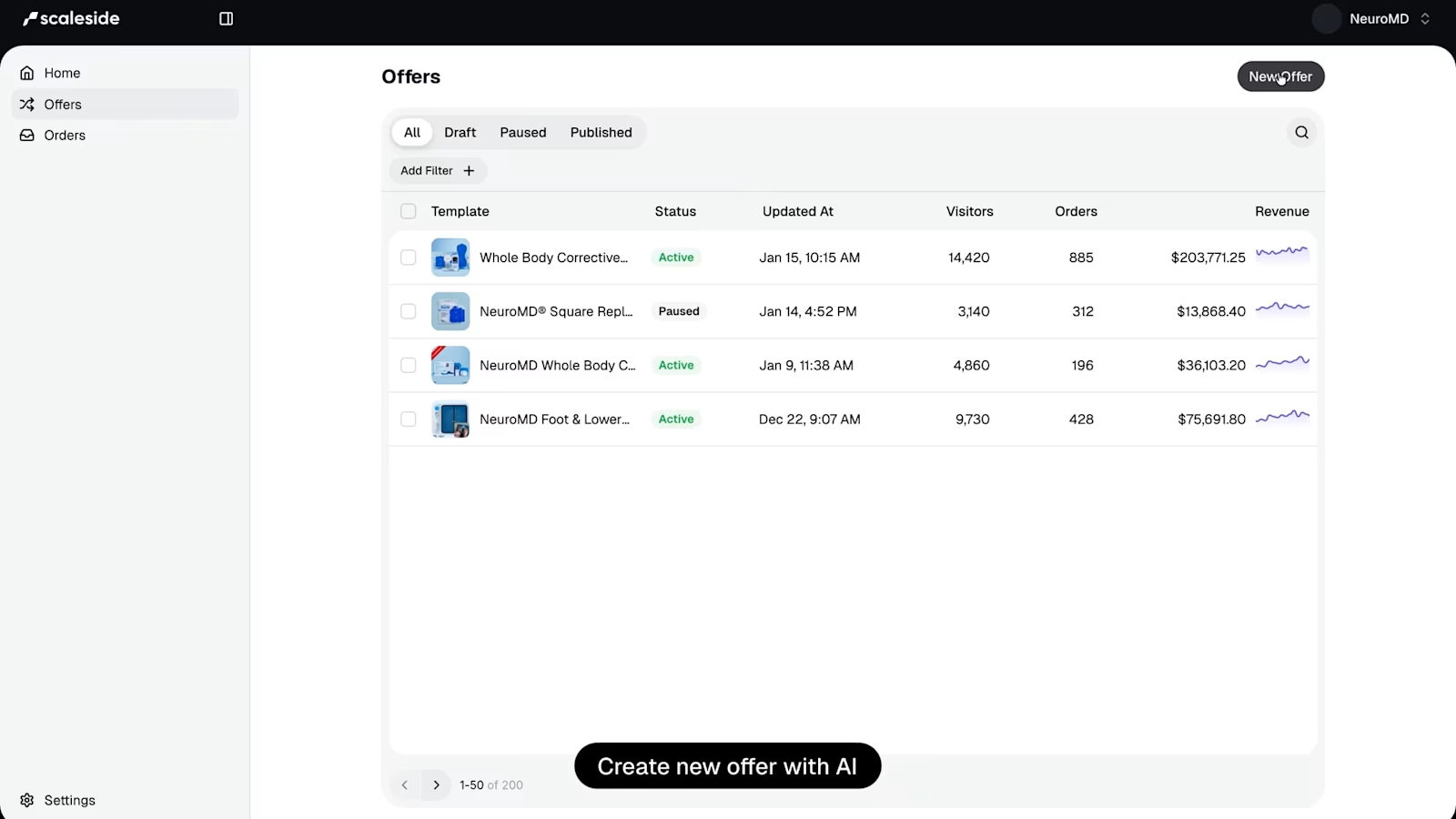
Opening frame of the Scaleside product walkthrough video.
Scaleside
B2B, eCommerce, Fintech, AI, Web (Responsive), Full-Scale Product Development

Scaleside is a B2B SaaS e-commerce platform that enables Shopify merchants to offer “Try Before You Buy” — customers pay only shipping upfront, use the product during a trial period, then get billed the full amount. It's a funnel builder with integrated payment orchestration, designed to increase conversion rates for high-consideration products ($50–100+). The client, a Miami-based operator running a $10M/year e-commerce business, validated the TBYB concept through his own sales data before commissioning the platform.

mira vertical
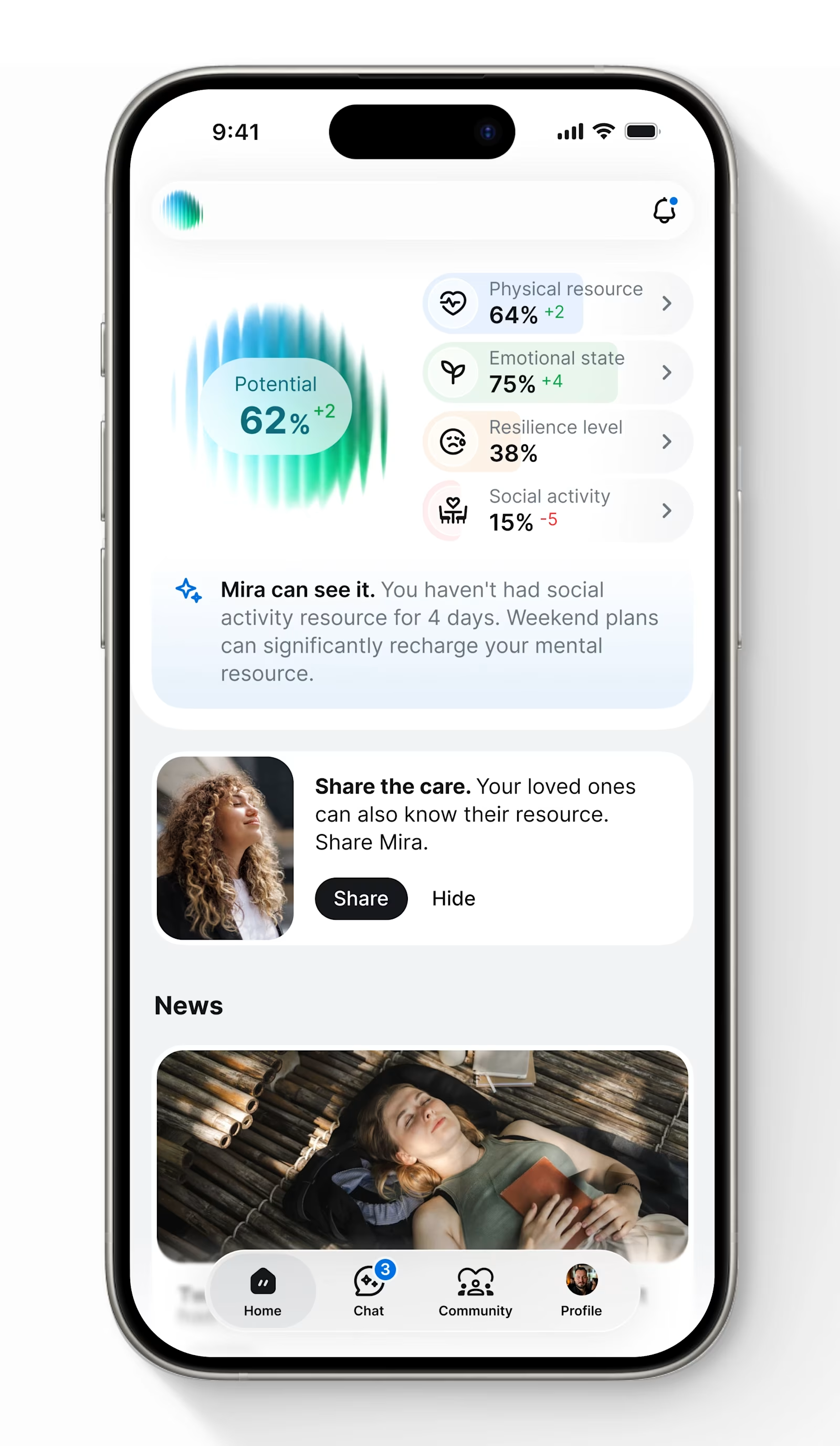
Mira
B2C, Healthtech, AI, Mobile (Flutter, iOS, Android), AI & ML Development

Mira is a comprehensive mental health platform combining community features, a Mental Health Battery dashboard (a composite wellness score derived from multiple dimensions), smartwatch and health data integration, and a sophisticated multi-agent AI chat system with four specialized agents. The concept is similar to Whoop or Garmin, but applied to mental health rather than physical fitness.