Hidden gem that sets business apart: AI corporate search (RAG).
Why AI search is essential for ambitious, forward-thinking businesses looking to elevate customer experiences and streamline internal operations: its impact across industries, the technical challenges, and the decisions behind a thoughtful implementation.

Abstract: This article reveals why AI search is essential for ambitious, forward-thinking business champions looking to elevate customer experiences and streamline internal operations. We explore the AI search impact on various industries, the technical challenges, and offer insights that guide you through thoughtful implementation decisions.
In the world of executive leadership, knowledge is the difference between good and exceptional.
Today, in a data-driven landscape, businesses are sitting on a goldmine of essential information — valuable customer insights, product expertise, and internal knowledge — all dispersed across documents, Zoom meetings, countless channels of communication, and knowledge bases. And often, you don’t even know where exactly a particular interaction occurred, where to search, or how to ask.
Extracting that precious wisdom efficiently and on demand can feel like finding a needle in a haystack.
Note: Throughout the article, we will be prompting “action items Jul 15, SDR” consistently across all Reliqio’s documentation to locate information transcribed during the Zoom call with the SDR (Healthtech) client.
Now, imagine a new team member seeking crucial onboarding information about your digital product. You want the data delivered to be accurate, immediate, and reliable. No one wants to spend priceless time or resources sifting through countless files or piecing together scattered data.
And traditional search tools? They often fall short, returning long lists of documents that require extensive filtering and reading, a frustrating and time-consuming process.
Here’s where AI corporate search or Retrieval-Augmented Generation (RAG) steps in — a solution designed to address the inefficiencies of traditional search tools.
What is RAG?
Simply put, Retrieval-Augmented Generation, or RAG, is an innovative AI search solution designed to harness your business’s collective knowledge, securely retrieve precise data, and use a human language AI assistant (similar to ChatGPT) to deliver crystal-clear, actionable answers within a fraction of a second.
RAG in action.
Let’s bring RAG to life with a real-world example and test the same “action items Jul 15” prompt across all Reliqio knowledge base, showing how it moves beyond traditional search to deliver a guided, intelligent, and solution-oriented digital experience.
To enrich the experience even further, RAG also provides precise pages and citations for further reading, giving users and team members the exact context they need without the guesswork.

Moreover, RAG seamlessly integrates with diverse document types, from PDFs and Excel files to web pages, tailoring its functionality to support every format in your digital ecosystem.
Measuring RAG’s ROI.
Evaluating impact means looking beyond initial costs because the real, lasting benefits for daily operations become apparent only over time.
For businesses that bring RAG into their workflow today, here are the key areas where it makes a fundamental impact:
faster decision-making as RAG cuts hours of manual searching to seconds.
boost in satisfaction scores with precise answers and reduced wait times.
drop in operational costs as RAG automates routine tasks, scaling efficiently.
improvement in first-contact resolutions with accurate, context-aware responses.
Executive advantage.
In the upper echelons of business, timing is everything.
While many organizations are still contemplating the future of corporate search, an elite group of industry pioneers like Accenture or Reliqio is already reshaping what’s possible. These leaders understand a fundamental truth: exceptional advantages belong to those who move first.
In pursuing excellence, it’s not enough to simply adopt technology — one must master it before others even recognize its potential.
Consider this: Only 3% of Fortune 500 companies have implemented advanced AI search solutions like RAG. This select group reports operational excellence and a fundamental shift in how they’re perceived in their industries. They’re not just managing information but wielding it as a strategic asset that sets them apart.
The difference is palpable in every executive meeting. When everyone else is still searching for answers, we’re already moving forward with insights-driven decisions. That’s the kind of advantage that defines market leaders.
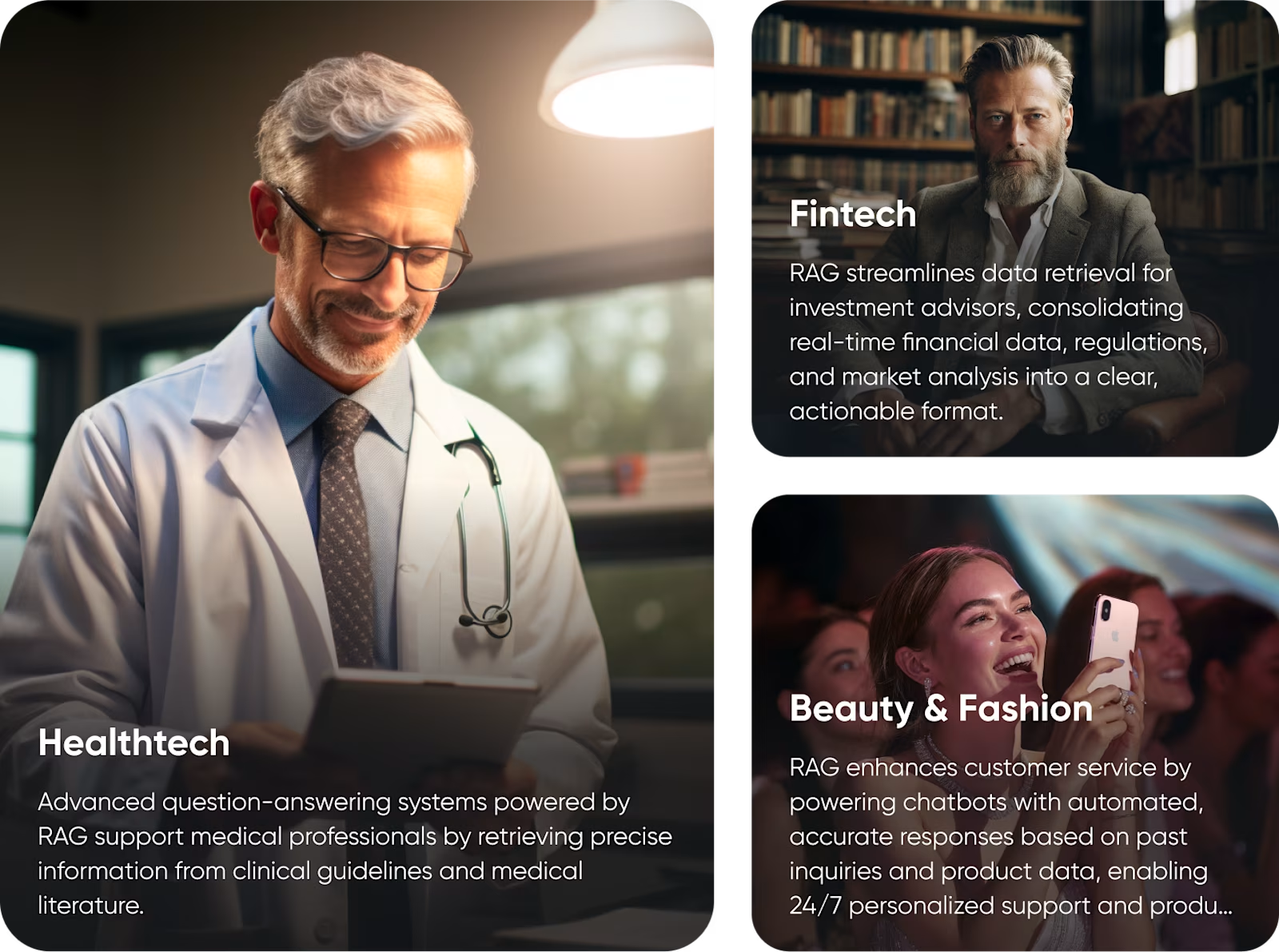
Industry-specific RAG application.
Every B2C industry that manages a substantial volume of data and documentation, particularly for premium customers, gains remarkable advantages from leveraging RAG.
Let’s dive into a few industries and see just how transformative RAG can be for them.
Tech-savvy section.
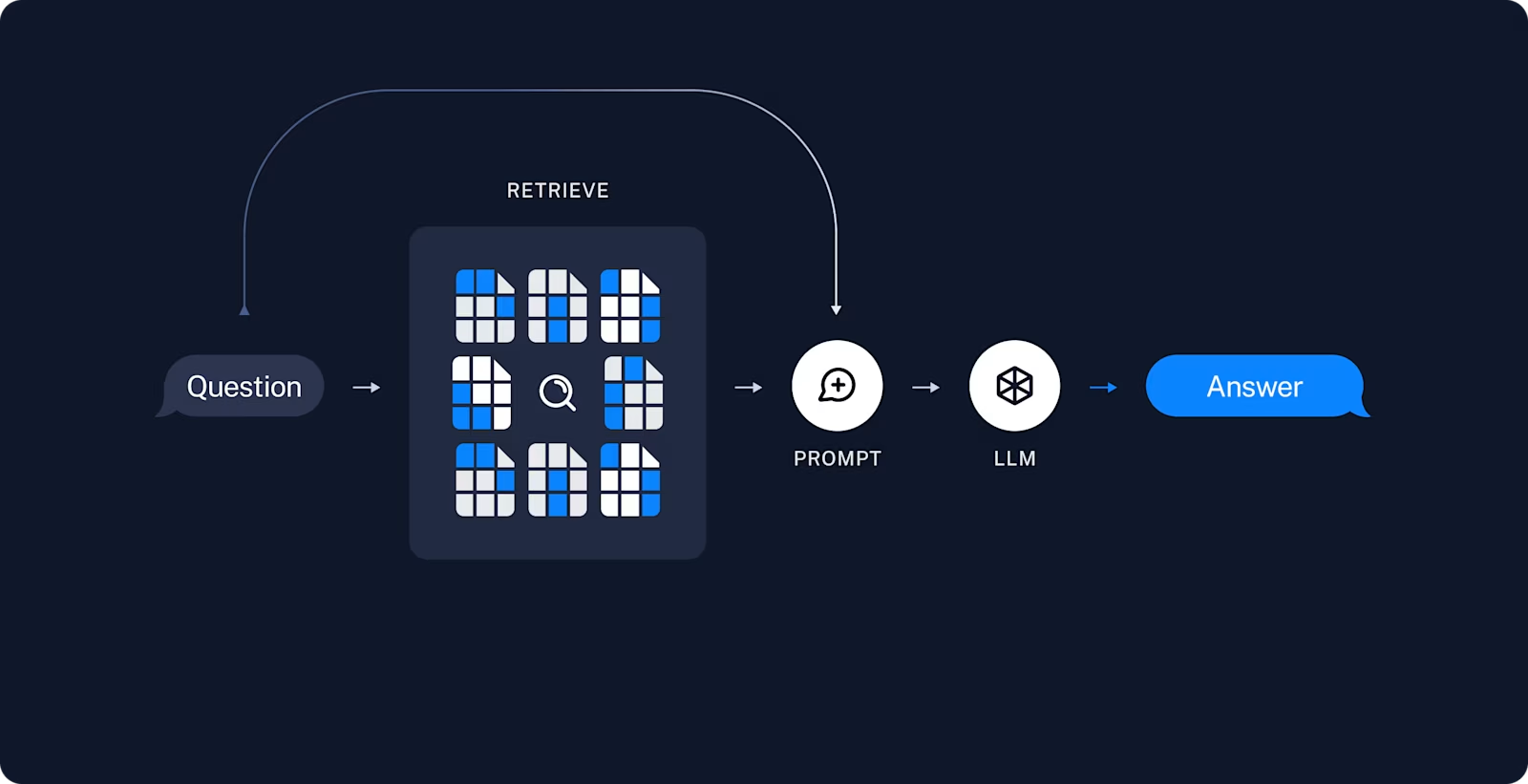
How does RAG work under the hood?
- Retrieve data. The system locates relevant information based on a user’s query, whether it’s product details, customer service FAQs, or complex technical documentation.
- Generate responses. The AI synthesizes the retrieved data into a human-readable answer, offering clear, tailored information that’s easy to understand and act on.
Implementing RAG in your business can be as simple or customized as needed. There are two main approaches:
- External model via API. Connect to large language models (LLM) like GPT-4o or Gemini through APIs, allowing RAG to handle retrieval and response generation without extensive infrastructure.
- In-house model. Deploy the model within your infrastructure, giving you complete control over data handling, privacy, and customization.
For those curious about the technical side, we’ve prepared a sample code repository demonstrating a basic RAG implementation. The following code example can serve as a foundation for your development team to evaluate potential integrations and customizations for your business.
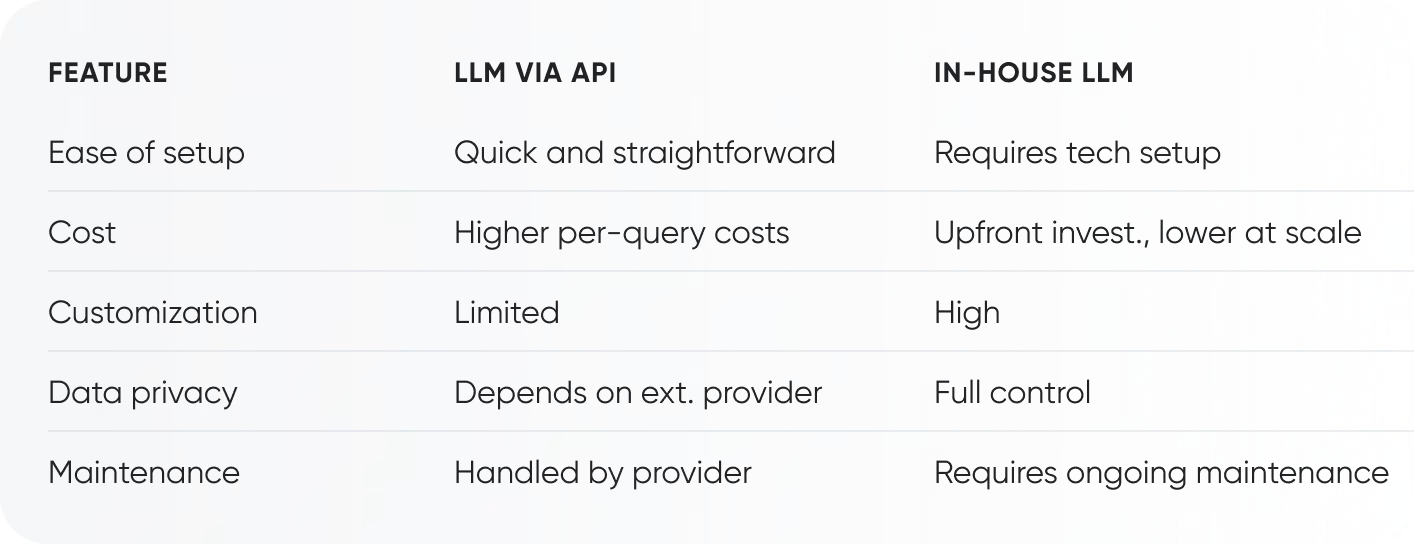
Each of the approaches above has benefits and trade-offs. Choosing the right one depends on your business’s unique priorities, strategic vision, operational capabilities, and customer expectations.
To help you make an informed choice, here’s a quick comparison of the vital factors for each approach:
Key questions to ask yourself:
- What immediate and long-term outcomes do we expect from RAG?
- How crucial is data control and privacy to our business model?
- Are we prepared to invest in and support in-house infrastructure? Do we have expertise?
The right choice for your business will balance the needs of today with the growth and security requirements of tomorrow.
Conclusion.
In a landscape flooded with information yet starved for clarity, RAG offers business champions like you a way to bridge the gap. RAG’s potential to transform customer support, internal knowledge management, and personalized marketing isn’t just theoretical — it’s an opportunity waiting to be realized.
By now, you’ve seen how RAG can elevate different aspects of business and how implementing it through an External Model via API or an In-House Model offers unique advantages. As you consider integrating RAG, reflect on which strategy impacts your business and customers the most.
And remember, those who take proactive steps toward innovation are the ones who lead and build a foundation for resilience, adaptability, and sustained growth.
Will you be among those who shape the future of executive decision-making or those who follow in their wake?